The Overfitting Epidemic in Algorithmic Trading
The democratization of machine learning tools (TensorFlow, PyTorch, Scikit-learn) has led to an explosion of retail and institutional algorithmic trading. It has also led to an epidemic of capital destruction, driven by a single, pervasive error: overfitting.
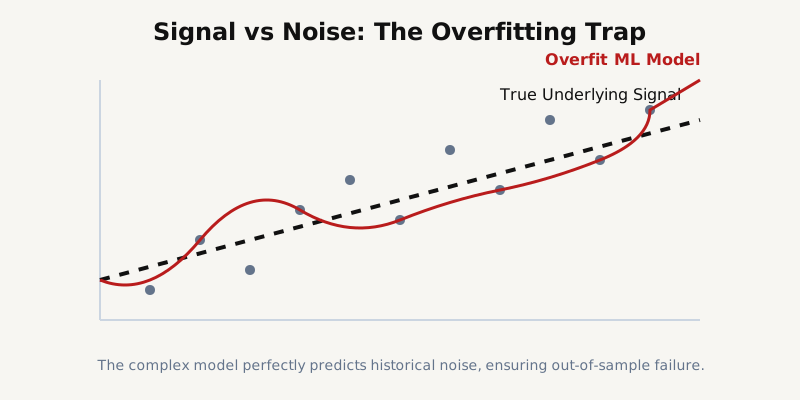
In financial machine learning, overfitting occurs when a model learns the noise in historical data rather than the underlying signal. The model produces a beautiful, upward-sloping equity curve in the backtest, only to fail immediately when deployed with real capital.
Why Finance is Uniquely Vulnerable
Overfitting is a problem in all data science, but finance is uniquely vulnerable for three reasons:
- Low Signal-to-Noise Ratio: Unlike image recognition, where a picture of a cat is definitively a cat, financial markets are dominated by noise. A stock's daily return is largely random variation around a tiny drift component. Complex models (like deep neural networks) are exceptionally good at memorizing this noise.
- Non-Stationarity: Financial data is non-stationary. The statistical properties of the market (mean, variance, correlation) change over time. A model trained during a decade of quantitative easing will fail during a high-inflation regime. See our guide on regime detection for how quants attempt to solve this.
- Multiple Testing Bias: This is the most insidious factor. If you backtest enough combinations of moving averages, RSI settings, and machine learning hyperparameters, you will inevitably find a combination that looks highly profitable by pure random chance.
The Illusion of the Sharpe Ratio
The Sharpe Ratio is the industry standard for measuring risk-adjusted returns. However, in the context of machine learning and heavy optimization, the standard Sharpe Ratio is dangerously misleading.
Marcos López de Prado, a pioneer in financial machine learning, demonstrated that the expected maximum Sharpe Ratio increases as a function of the number of trials (backtests) run. If you run 1,000 backtests on random noise, the "best" strategy will have an annualized Sharpe Ratio well above 1.5.
The Deflated Sharpe Ratio (DSR)
To combat multiple testing bias, quantitative researchers use the Deflated Sharpe Ratio. The DSR adjusts the estimated Sharpe Ratio downward based on three factors:
- The number of independent trials (backtests) attempted.
- The variance of the Sharpe Ratios across all trials.
- The length of the out-of-sample track record.
If you test 10,000 variations of an AI trading algorithm to find one with a Sharpe of 2.0, the DSR will likely reveal that the true expected Sharpe is closer to 0.
Defending Against Overfitting
Robust quantitative research requires a strict protocol to prevent curve-fitting:
1. Feature Importance over Complexity
Before deploying a deep learning model, test a simple linear regression. If the linear model fails to capture any signal, it is highly likely that your complex neural network is just fitting noise. Simpler models generalize better.
2. Walk-Forward Optimization (Purged Cross-Validation)
Standard k-fold cross-validation fails in finance because time-series data is autocorrelated. If you use future data to predict past data, information "leaks." Quants use Purged Cross-Validation, which drops (purges) observations near the test set to prevent leakage.
3. Out-of-Sample Testing
Never touch your out-of-sample (holdout) data until the model is finalized. If you test on the holdout set, tweak a parameter, and test again, your holdout set is now in-sample, and your results are invalid.
4. Stress Testing Distributions
Don't rely solely on historical price paths. Use a Monte Carlo Simulator to generate synthetic, statistically similar market environments. If your strategy fails on synthetic data, it is overfit to the specific historical path.
5. Proper Sizing
Even with robust testing, uncertainty remains. Never size positions based on the exact win-rate of the backtest. Apply a fractional Kelly Criterion to buffer against the inevitable degradation of the edge in live trading.