Beyond Sentiment: NLP in Earnings Calls
The application of Artificial Intelligence in investing is often misunderstood as simply plugging stock prices into a neural network. In reality, the most persistent alpha generated by AI in the last decade has come from unstructured text data—specifically, Natural Language Processing (NLP) applied to earnings calls, 10-K filings, and central bank minutes.
For years, the standard approach was simple dictionary-based sentiment analysis. Today, that approach is obsolete.
The Flaw of the Loughran-McDonald Dictionary
In 2011, Tim Loughran and Bill McDonald published a seminal paper demonstrating that standard sentiment dictionaries (like the Harvard IV-4) misclassify financial text. Words like "liability," "tax," or "vice" are negative in general English but neutral in finance.
They created the Loughran-McDonald Master Dictionary, which became the industry standard. (You can test this approach using our Sentiment Scorer tool).
However, dictionary approaches have a fatal flaw: they lack context.
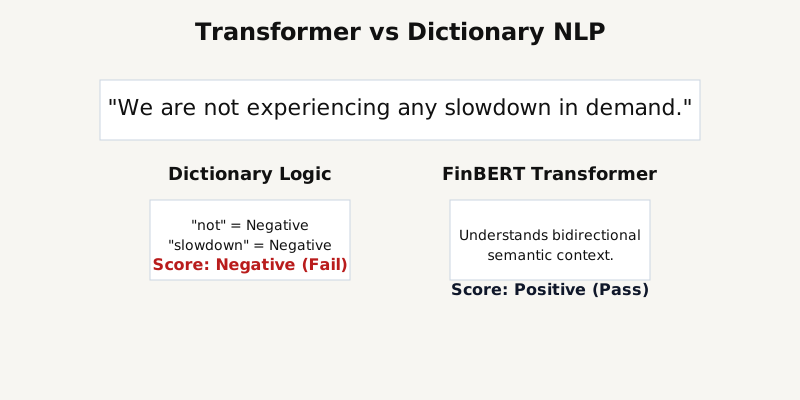
Consider the phrase: "We are not experiencing any slowdown in demand." A dictionary model sees the words "not" (negative) and "slowdown" (negative) and scores the sentence poorly. The actual meaning is highly positive.
The Transformer Era: FinBERT
The introduction of transformer architecture (like Google's BERT in 2018) revolutionized NLP by processing words in relation to all other words in a sentence, capturing context.
Financial institutions quickly realized that a general-purpose BERT model didn't understand finance any better than a general dictionary did. This led to the development of FinBERT, a model pre-trained on a massive corpus of financial text (TRC2-financial, earnings call transcripts, and analyst reports).
What Funds Actually Extract
Modern quant funds aren't just looking for "positive" or "negative" sentiment. They use FinBERT and custom Large Language Models (LLMs) to extract nuanced behavioral signals:
- Executive Evasion: Models measure the semantic distance between an analyst's question and the CEO's answer. If an analyst asks about margin compression in Europe, and the CEO answers about revenue growth in Asia, the model flags high evasion. Studies show high evasion correlates with subsequent underperformance.
- Uncertainty Quantification: Rather than looking for bad news, models look for words indicating lack of clarity (e.g., "fluctuating," "ambiguous," "contingent"). High uncertainty scores often precede volatility expansion. Options traders use these signals to adjust implied volatility assumptions in pricing models.
- Thematic Clustering: NLP models cluster unigrams and bigrams to detect emerging risk factors before they hit the mainstream. For example, supply chain mentions spiking across a sector weeks before macroeconomic data confirms it.
The Alpha Decay of NLP
As with all quantitative strategies, the edge decays as adoption increases.
In 2015, simply buying companies with positive sentiment divergence was a profitable strategy. Today, that signal is entirely commoditized. Algorithms parse the 8-K filing and execute trades in milliseconds.
To maintain an edge, researchers are moving beyond the text itself to vocal prosody analysis. By analyzing the raw audio files of earnings calls, deep learning models can detect micro-tremors, pitch variations, and speech rates in a CEO's voice to identify stress or deception—signals that do not appear in the written transcript.
Implementing NLP Safely
If you are developing NLP-driven signals for a systematic strategy, backtesting is fraught with danger. You must ensure point-in-time accuracy (the transcript was available exactly when the trade was executed) and avoid overfitting your model to the specific jargon of a past market regime.
Furthermore, NLP signals should rarely dictate the sizing of a position on their own. They are typically used as an input feature in a broader model, with final allocation determined by robust risk management frameworks like the Kelly Criterion and stress-tested via Monte Carlo simulations.